




Goodbye, Goodison Park: What Will Happen to the Everton Stadium?
Lost Grounds · 10 June 2025 · 6 min read
Carsten Germann
Since May 18, 2025, Goodison Park, home of Everton FC, has also become one of the lost grounds in Great Britain. The historic stadium first opened in 1886 and is a symbol of vibrant English football culture.
It all started with a dispute. After differences with a certain John Houlding (1833–1902), then mayor of Liverpool and later founder of Liverpool Football Club, Everton FC left its former home at Anfield Road in 1882 and relocated.
Just a mile away, a five-minute walk across Stanley Park, a new stadium was built – Goodison Park.
As early as 1894, Goodison, then with a capacity of 37,000, hosted the English FA Cup Final for the first time. Notts County beat Bolton Wanderers 4–1.
The expansion of the Gwladys Street Stand made Goodison Park, in 1938, the first stadium with two-tier stands on all four sides.
Goodison saw its largest crowd in 1948 when 78,299 fans filled the ground for the Merseyside Derby against LFC (1–1).
For the German national team, Everton became a place of longing during the 1966 World Cup in England: 2–1 in the semifinals against the USSR. No other English stadium hosted more World Cup matches than Goodison (5).
Borussia Mönchengladbach had less luck. The “Foals”, who lost to Everton’s archrival Liverpool FC in the UEFA Cup and European Cup finals in 1973 and 1977, respectively, also lost the first penalty shootout in European Cup history 3–4 in the 1970 quarterfinals.
From 1970 to 1974, Everton FC could boast the largest spectator stand in England with its three-tiered Main Stand.
So much for a journey into the glorious past of the “Grand Old Lady” among English stadiums.
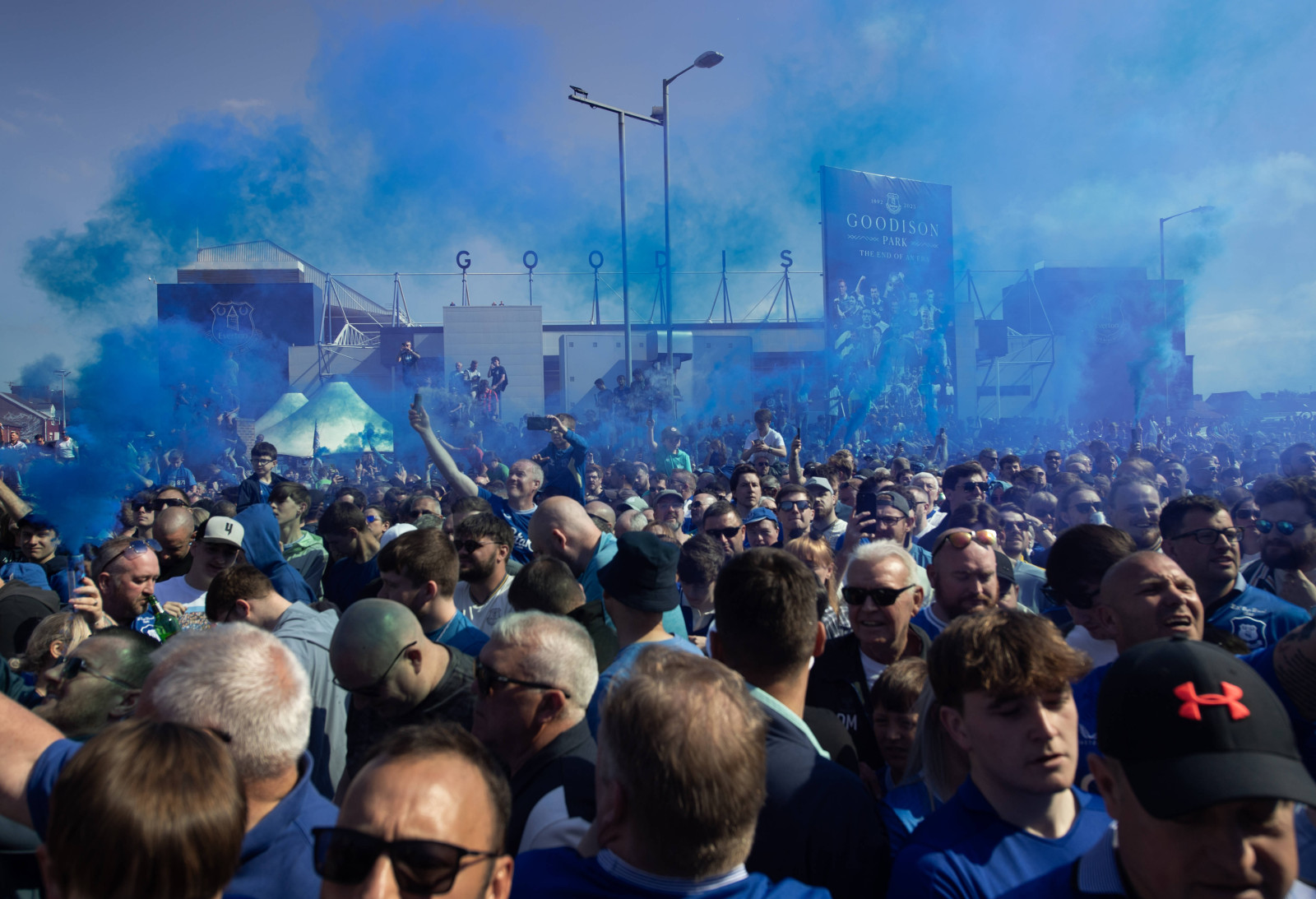
May 18, 2025: One last time, Everton fans welcome their team at Goodison Park. The historic arena saw 122 years of top-flight football in England. Photo: Imago Images / Visionhaus
Goodison Park: 122 Years of Top-Flight Football
Back to the future: From summer 2025, Everton FC will play at the newly built Hill Dickinson Stadium, just over two miles from its former home. Built at the Bramley-Moore Docks, it cost £800 million.
The home match on May 18, 2025, against relegated Southampton FC marked the 122nd and final season at Goodison Park for Everton FC.
No other stadium has hosted more top-flight English league matches.
Everton won eight of its nine English league titles here and avoided relegation in 1994 with an epic 3–2 comeback against Wimbledon FC at Goodison, having been 0–2 down, preserving their place in the Premier League.
Before that match, some fans sought comfort in St. Luke’s Church, located just behind the Gwladys Street Stand and surrounded by the narrow streets of traditional English brick terraced houses.
I also wrote about this match in my 2007 book Football’s Home – Stories from English Football (Publisher: DIE WERKSTATT). A timeless Premier League relegation battle classic, rightly featured in the BBC’s Match of the 90ies retrospective at the end of the league’s first decade.
“The Great Escape” at Goodison – 20,000 Fans Without Tickets on the Streets
For me personally, it was the greatest game ever at Goodison.
By midday, crowds were already massive outside the stadium gates. People stood on the windowsills of nearby terraced houses to catch a glimpse inside. They climbed the trees in Stanley Park and waited by the entrances. “I think there were at least 10,000 people outside without tickets,” recalled then Everton manager Mike Walker.
In fact, nearly 20,000 Everton fans without tickets made their way to the stadium. Additionally, there was a massive backlog at the gates since Goodison Park could only be entered from three sides that day due to construction at the Stanley Park End Stand.
“We’re going to be relegated today”
The “Toffees” had the advantage of being the only relegation-threatened club playing at home, while Sheffield United visited Chelsea FC and Ipswich played at Blackburn Rovers.
After just 21 minutes, and an own goal by Gary Ablett, Everton were 0–2 down to Wimbledon FC. The stands were filled with stunned silence. “There was a sense of resignation,” Everton fan Lyndon Lloyd recalled. “It all felt surreal, like a dream. I thought: Today we’re going down! Even though I couldn’t imagine life outside the Premier League.”
At halftime it was 1–2, and time was running out for Everton. Things got worse when Sheffield took the lead at Chelsea. Then, in the 68th minute, Barry Horne struck from 22 meters – 2–2. Still not enough, as Ipswich held a 0–0 at Blackburn. Fans began to pray. Never had they wanted a goal from Blackburn striker Alan Shearer more. Then came the pass from Tony Cottee to Graham Stuart, who struck from the left – 3–2. Goodison erupted in joy. Everton stayed up with 44 points, ahead of Ipswich (43).
“The sense of family,” wrote Everton fan and author Simon Hart in Kicker-Sportmagazin (April 14, 2025 issue), “is amplified by former players who still show up.”
True. You could still bump into Everton legends like Paul Power, 1987 English champion (Everton’s last title), or Anders Limpar, part of the 1995 FA Cup-winning team – always happy to chat around Goodison.
That same family spirit filled the streets of Liverpool-Everton on the final day. A party among the terraced houses, one last fan march to the ground, and in front of the famous stadium pub “The Winslow Hotel” (The People’s Pub / 31, Goodison Road, Liverpool L44EH), a sign titled “The Goodison Gang” listed the Toffees’ nine league titles one last time.
No Demolition: Who will play at Goodison Park?
Those days of Premier League football in tight streets and walkable Merseyside derbies are now nostalgic memories. Goodison is now a “Lost Ground”.
Wait a minute! Lost ground? Not quite. Only for the men’s Premier League. Unlike Arsenal, which turned its former home Highbury into luxury flats after its 2006 closure, Everton’s women’s team will play their Women’s Super League home matches at Goodison. The club confirmed this in mid-May 2025. The venerable Goodison Park is to become “a distinctive venue in European women’s football.”
And rightly so.
Last Merseyside Derby: Goodison goes crazy
The dynamic energy of this stadium was on full display in February 2025. Deep into stoppage time of the last Merseyside Derby against future champions Liverpool FC, James Tarkowski equalized at 2–2, sparking absolute chaos. The 120th and final Merseyside Derby at Goodison ended with 41 wins for the often-disparaged LFC.
“When Tarkowski’s shot hit the net,” Simon Hart described the moment, “the sardine-can tightness resembled the old standing terraces.”
A more beautiful farewell tribute to Goodison is hard to imagine.
Don't miss an update
Get selected highlights about sports, events and travel - short, relevant, no spam.