




Multi Club Ownership vs. UEFA: These Clubs are affected
Fussball News & Infos · 17 July 2025 · 6 min read
Carsten Germann
The case of Crystal Palace and the demotion of the English Cup winner to the Europa Conference League, despite qualifying for the Europa League after winning the first title in club history, is making waves across football Europe. The Londoners are a prominent “victim” of so-called Multi Club Ownership. But what’s behind this term, and why is the ugly word “distortion of competition” being used?
Crystal Palace fans took to the streets in South London on July 15, 2025. They protested against the European football association (UEFA) after marching to Selhurst Park stadium.
Their team was relegated to the Europa Conference League due to the so-called Multi Club Ownership Rule – U.S. investor John Textor held shares in both Palace and the also Europa League-qualified French club Olympique Lyon.
“UEFA: Moral Bankruptcy” – that was one of the more harmless banners displayed on the façade of Selhurst Park.
The demotion of Crystal Palace was described by Vice President Steve Parish as “a bad day for football” and a “terrible injustice.”
Parish told the BBC: “We’ve been excluded from a European competition over a completely ridiculous technicality.”
Crystal Palace missed the March 1, 2025 deadline to prove a possible Multi Club Ownership. At that time, “The Eagles” had not yet secured the FA Cup win or qualification for the Europa League.
“At the end of the day, it’s an injustice based on formal errors,” said Crystal Palace fan and podcaster Nick Philpot, “we won the cup and they are punishing the entire club and its fanbase.”
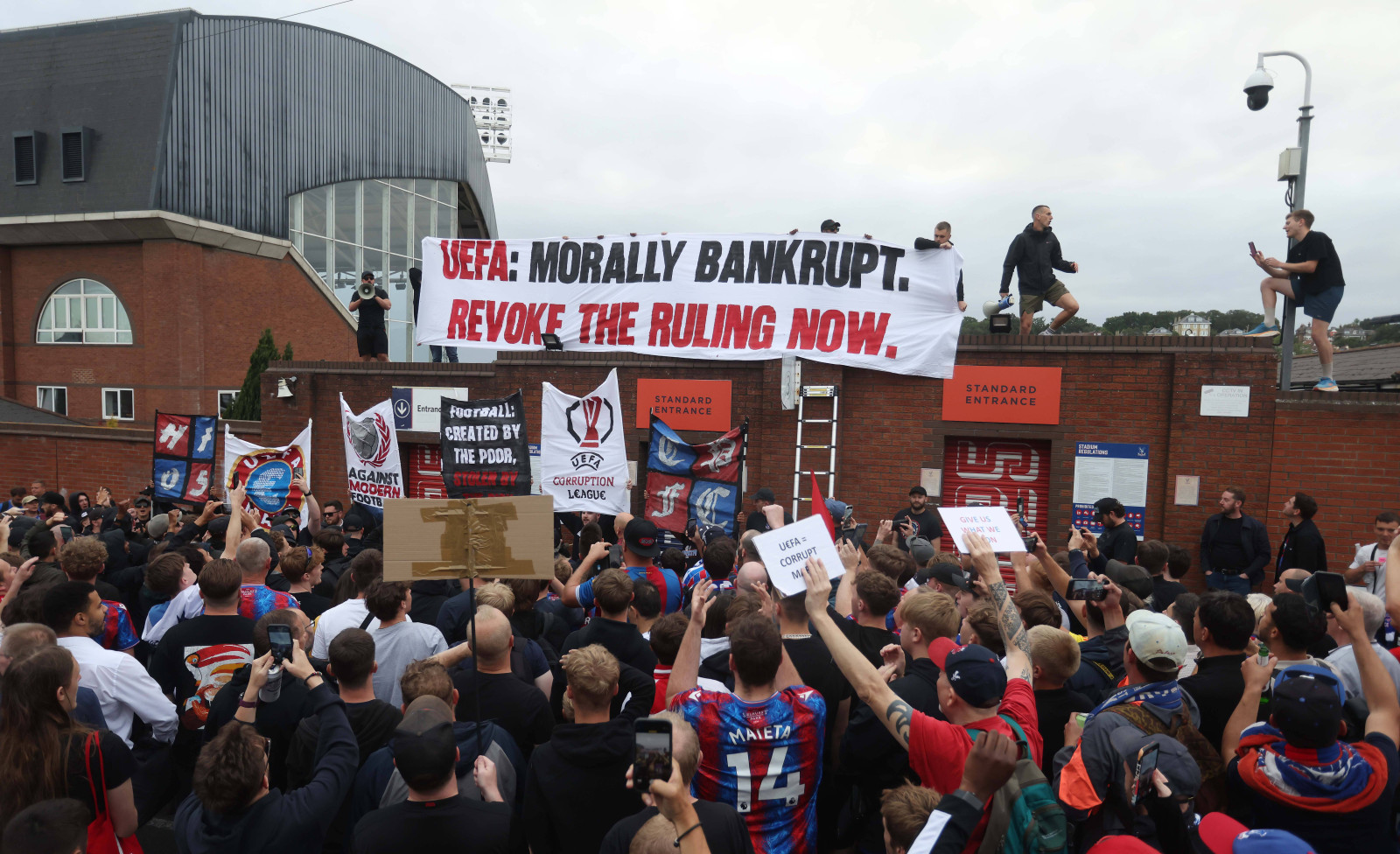
July 15, 2025: Crystal Palace fans protest outside Selhurst Park Stadium against the club’s demotion to the Europa Conference League due to UEFA's “Multi Club Ownership” regulations. Photo: Imago Images / Crystal Pix
What is Multi Club Ownership in football?
Multi Club Ownership trap – This means that investors can hold significant stakes in several football clubs, which do not have to be from the same league or even the same country. According to UEFA, this can lead to a distortion of competition.
Multi Club Ownership rules: Why did it affect Crystal Palace?
UEFA's current regulations state that two clubs controlled by the same investor or owner may not participate in the same season of the three European competitions (Champions League, Europa League, Conference League).
If both clubs qualify for the same competition, their domestic league position decides – and here, “OL” finished fifth in France’s Ligue 1, ahead of Premier League club Crystal Palace (12th).
UEFA also deemed John Textor’s (see above) sale of his Palace shares to be too late.
Multi Club Ownership also affects transfers. UEFA prohibits clubs under Multi Club Ownership scrutiny from transferring players between each other during the season in which they participate in the same competition, or during the first transfer window.
So far, so strict. But UEFA’s Club Financial Control Body (CFCB) has recently made some remarkable decisions in relation to six clubs – all of which contrast with the “Crystal Palace case.”
Which football clubs are connected?
Example: Manchester United and OGC Nice. Both clubs are funded by chemical giant INEOS but were allowed to play in the Europa League in 2024/2025. Nice finished 35th in the new league system, while Manchester United advanced to the final in Bilbao (0:1 vs Tottenham) as third place in the group stage.
Example: Aston Villa and Vitória Guimarães. The 1982 European Cup winner from England and the traditional Portuguese club are part of the V-Sports group owned by U.S. billionaire Wes Edens and Egyptian businessman Nassef Sawiris.
“The Villans” and Vitória both qualified for the Europa Conference League in 2023 – and were allowed to participate because the ownership group reduced its shares and withdrew from the club boards.
Example: AC Milan and FC Toulouse. The multiple Champions League winner from Milan and the Ligue 1 club are both owned by the U.S.-based RedBird Group. In this case too, both clubs were recently allowed to compete in Europe, since AC Milan finished fourth in Serie A 2022/2023, qualifying for the Champions League, while “TFC” qualified for the Europa League as French Cup winners.
Example: Manchester City and FC Girona. The Spanish side sensationally reached the new league phase of the Champions League in 2024, where they played alongside Manchester City, managed by the City Football Group.
Especially notable: The FC Girona Group, which owns 44.3 percent of the club, belongs to Pere Guardiola – the younger brother of City’s head coach Pep Guardiola.
That fact alone should have led to one of the clubs being excluded from the Champions League, but UEFA stated “it was proven that the clubs had made changes to their management.” According to UEFA, these changes ensure that “no natural or legal person exercises decisive control over more than one club.” Well then…
Multi Club Ownership in the Champions League: How Red Bull passes the ball to itself
The most famous Multi Club Ownership model comes from Austria. Since 2005, energy drink giant Red Bull has operated clubs in Salzburg, Liefering, Leipzig, and New York as a football franchise. Nearly two dozen players have transferred between Leipzig and Salzburg alone.
Both RB clubs played in the new Champions League league phase in 2024/2025 – with no objections from UEFA.
Multi Club Ownership in the Premier League: The Big Greek of Nottingham
There is no internal Multi Club Ownership model within the Premier League itself, but AFC Bournemouth’s owner, U.S. businessman Bill Foley, purchased exactly 29.9 percent of Hibernian Edinburgh from the Scottish Premiership in 2024.
Chelsea's U.S. owner Todd Boehly acquired the club from Stamford Bridge from Russian oligarch Roman Abramovich in 2022 and also holds shares in Racing Strasbourg in Ligue 1.
The Alsatians might have benefited from Lyon’s forced relegation with a Europa League ticket.
Liverpool FC, like FC Toulouse and AC Milan, is partially owned by the RedBird Group. Here too, UEFA took no action in 2024 when Milan and “The Reds” met in the Champions League league phase.
Last but not least: Nottingham Forest. Greek shipping tycoon Evangelos Marinakis owns 100 percent of the “Tricky Trees” and is also co-owner of Olympiakos Piraeus, whom he led to become the first Greek club to win a European trophy in 2024 by winning the Conference League.
Don't miss an update
Get selected highlights about sports, events and travel - short, relevant, no spam.