




Old Wembley Stadium: Dietmar Hamann Had the Final Word
Lost Grounds · 14 November 2024 · 7 min read
Carsten Germann
Complete destruction in London! On October 7, 2000, it was finally over, on this historic day, Wembley became a “Lost Ground”. In the London rain, it wasn't "The last one closes the book," but "The last one closes Wembley.”
This was, in this very special case, the Liverpool professional Dietmar Hamann ("The Didi Man") with a free-kick goal from a distance to make it 1-0 for Germany in the World Cup qualifying match against England.
The last game in its 1923 opened football opera, where on July 30, 1966, England's greatest success in football history took place with the World Cup win against Germany (4:2 after extra time) and the name-giving "Wembley Goal," ended in a defeat for England. The fans were typically British-smart: "Goodbye, Wembley, thank you for the memories," read one of many posters in the stands.
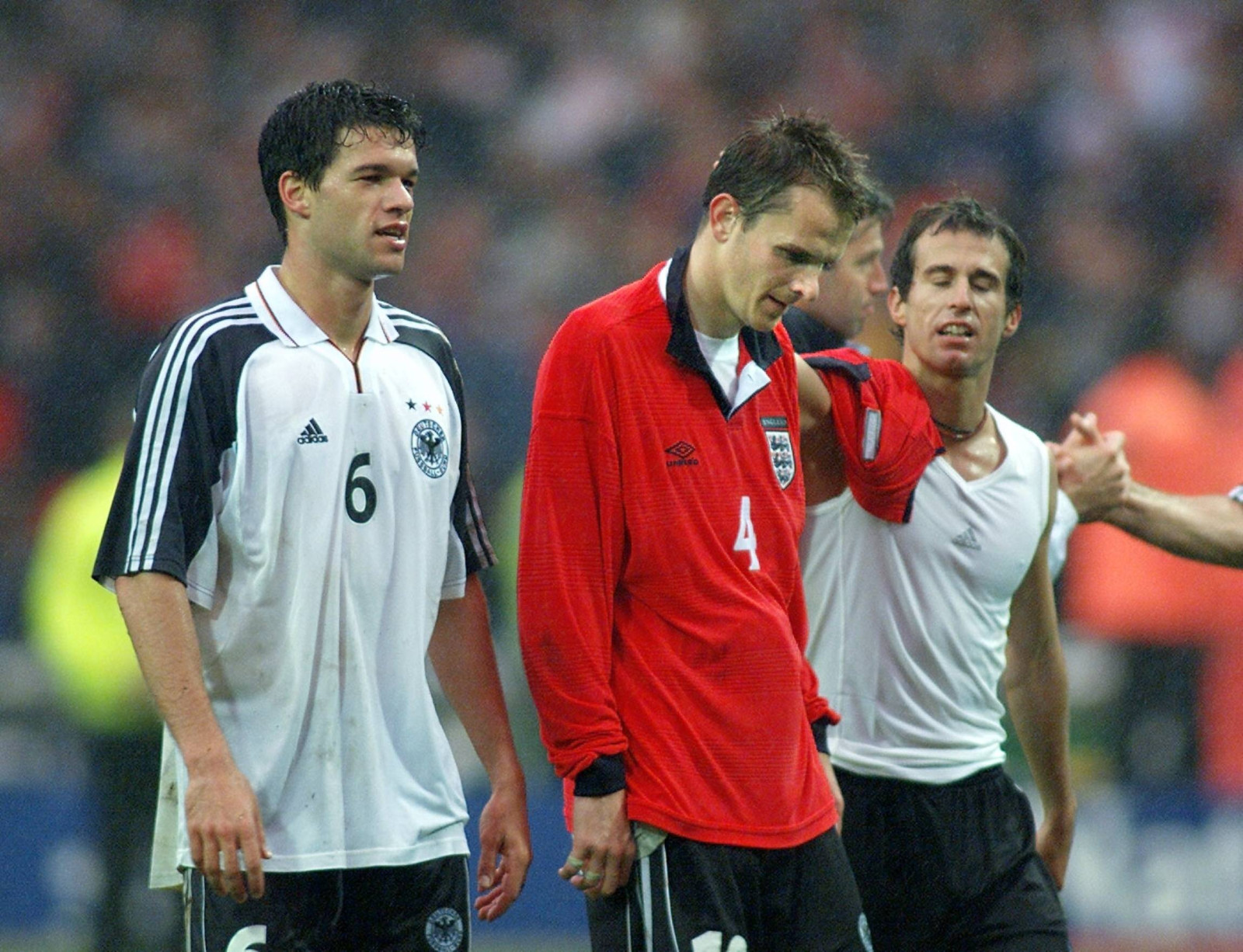
October 7, 2000: The German national players Michael Ballack (l.) and Mehmet Scholl (r.) leave with Dietmar Hamann (m.), the last goal scorer in the old Wembley Stadium, the most historic ground in the world. Photo: Imago / Pressefoto Baumann
Almost 750 million British pounds were the cost of the spectacular Wembley rebuild at the same location. "The Home of Football" was actually supposed to open in 2005. But everything was only finished in March 2007, and the FA Cup Final 2007 with FC Chelsea and Manchester United became the first big game in the new football temple of Wembley.
“The Church of Football”
Wembley – This is the stone-turned landmark of English football. The gaze almost automatically goes to the 133-meter-high arch that spans the stadium and has replaced the legendary "Twin Towers," the snow-white twin towers, as the stadium's trademark.
No place has yet combined myth, tradition, and modernity as perfectly as Wembley. The great Pelé ("O Rei" / † 2022) once referred to the stadium as the "Church of Football." And this, even though he himself never played at Wembley and only once – on a brief visit in a suit and dress shoes – kicked the ball into the empty net.
The Brazilian football king, however, had been to the "old" Wembley.
It was the wish of King George V to build a stadium in northwest London that could serve as a worthy stage for the 1924 "British Empire Exhibition." In just one year of construction, a stadium made of 25,000 tons of concrete and steel was driven into the ground – for today’s laughably small sum of 825,000 euros.
On April 28, 1923, England first felt the heartbeat of this mighty arena, which from the beginning was a fascination due to its design. Wembley was also a monument of the Empire.
The first top event at Wembley was the FA Cup Final between Bolton Wanderers and West Ham United. After a slow ticket sale, 126,000 people crowded into the stadium by noon. The police were at a loss, and Constable George Albert Scorey helped to push the crowd back onto the pitch with his gray horse, Billy.
Billy became a legend as "The White Horse" of Wembley. "Billy was gentle," Scorey later recalled, "he gently nudged people with his nose and tail over the goal line."
1940: Football Temple as a Troop Barracks
The outbreak of World War II and the evacuation of the British Expeditionary Force from the French coastal town of Dunkirk in 1940 turned Wembley into a collection point for exhausted soldiers. It wasn’t until April 27, 1946 that the FA Cup returned. Only then did Derby County and Charlton Athletic play the first English Cup Final after the war.
In November 1953, Hungary's "Magical Magyars," known in their homeland as "The Golden Eleven," appeared with the outstanding "Major" Ferenc Puskás and wonder striker Nándor Hidegkuti in "England's traditional football fortress" (Dieter Kürten). What until then everyone on the island thought impossible came true: Hungary beat England for the first time in its seemingly impregnable national stadium – 3-6, a humiliation.
The goalkeeper Bernd "Bert" Trautmann broke another taboo in 1956. The Manchester City keeper, who had arrived in England as a prisoner of war in 1944, became the first German to win the FA Cup. On May 5, 1956, the Bremen-born Trautmann came with Manchester City to the FA Cup Final at Wembley against Birmingham City. With the score 3-1 for the "Citizens," Trautmann was seriously injured in a collision with Birmingham's Peter Murphy. With a broken neck vertebra, Trautmann continued to play, surviving a second collision.
Before the demolition, seven European Cup finals were held at Wembley. Three times, English clubs used their "home advantage" with West Ham United (1965 against 1860 Munich), Manchester United (1968), and FC Liverpool (1978).
The “Wembley Roar”
Wembley is one of the few stadiums in the world with its own song. In 1947, "The Man in the White Suit" appeared for the first time. He was London headmaster Arthur Craiger, who took on the task of preparing the crowd for the Cup Final with Charlton and FC Burnley. On that day, 98,215 spectators were in the stadium. The song "Abide with Me" made Craiger a nearly mystical figure in the Wembley theater and was the crowd motivator for the finals until the early 1960s. Even more famous than "Abide with Me" is the "Wembley Roar," the much-described, sometimes even mystified sound of the crowd.
England's World Cup champion George Cohen described the "Roar" in 1998 as a "sound like a train or a subway that drove everything out of your head."
Geoff Hurst, the three-time goal scorer in the 1966 World Cup final against Germany (4:2 after extra time) and the last still-living English World Cup champion from the starting lineup of national coach Sir Alf Ramsey, remembered the "Roar" much more than his legendary "Wembley Goal" in the 101st minute: "The noise sounded like a crescendo. That's something I will always take with me from that game," Hurst said in 2016 to Football Travel editor Carsten Germann. "It was as if the entire nation was in the stadium."
Although there were only 96,924 people in the stadium on that July 30, 1966, the World Cup united England as a nation like no other tournament before. We won the Cup, we won the Cup, ee ay adio we won the Cup, they sang afterwards in London and elsewhere.
Glory and glamour also came to Wembley from personalities who were not necessarily in football contexts. Like Bob Geldof. The former lead singer of the Boomtown Rats organized the biggest concert of all time in the summer of 1985: Live Aid.
The event, aimed at helping the starving population in Africa, attracted 70,000 music fans, and 1.4 billion TV viewers watched the performances of ex-Beatle Sir Paul McCartney, Sir Elton John, and Queen with the incomparable Farrokh Bulsara, known as Freddie Mercury († 1991).
Wembley is a Once in a Lifetime moment for many. Like for Paul Allen of West Ham United. At 17 years and 256 days, he was the youngest player in an FA Cup final in 1980. In the London derby, "The Hammers" won 1-0 against Arsenal to win the FA Cup, and the young player had to be supported by his teammates after the victory ceremony, crying with joy.
Lineker's Return
Comfort was also needed by a certain Gary Lineker when, in 1969, at the age of eight, he traveled home after a 0-1 defeat of his beloved Leicester against Manchester City in the FA Cup final at Wembley. Little Gary cried on the way home. "I never thought I would return to Wembley as a player," Lineker later recalls, who scored 47 goals in 80 international appearances for England. In 1991, he won the FA Cup with Tottenham Hotspur at Wembley.
That's why Lineker deserves the last word on Lost Ground Wembley: "At some point, it was time to do something new. Wembley was a place with a great history, but over time, the stadium had become quite run-down. Some facilities, like the toilets, were just hopeless."
Don't miss an update
Get selected highlights about sports, events and travel - short, relevant, no spam.