




A Football Trip to Belfast: In the Footsteps of George Best
Premier League Offside · 25 October 2024 · 5 min read
Carsten Germann
George Best (1946 – 2005) – Northern Ireland's exceptional footballer is still omnipresent in Belfast even 50 years after his last game for Manchester United. I witnessed this myself on a tour through Ireland and Northern Ireland during the international break in October 2024. George Best and Belfast – Should the Northern Irish capital (hopefully) remain a host city for EURO 2028, it’s a must-visit for every traveler.
We had already visited the Titanic. On our last day before returning to Dublin, we visited the museum in Belfast and the former dock of the legendary yet ill-fated passenger ship.
Then, chauffeured by our tour guide, Cologne historian Dr. Ingo Niebel, we went on a search for traces throughout Belfast.
50 Years Ago: George Best in His Final Chapter
George Best – He’s an essential stop when visiting the Northern Irish metropolis.
The legendary winger, who last played for Manchester United on January 1, 1974 (George Best in his final chapter), remains omnipresent in his hometown almost two decades after his death.
While the hero worship of “Bestie” cannot be compared to the nearly idol-like reverence for Diego Armando Maradona († 2020) in Naples, there are plenty of markers that keep the memory of George Best, the football-gifted “Belfast Boy,” alive.
The centerpiece is, of course, the George Best House, his former residence, 16 Burren Way, in the Cregagh neighborhood in the southeast of the city. Best lived here until his move to Manchester United in 1963.
Tip from event-breaks.com: Be sure to schedule a visit at least one week in advance, as the George Best House cannot always provide a tour guide, even on open days.
The facade of the George Best House is adorned – as in many other parts of Belfast – with a mural, a wall painting of the “fifth Beatle,” as the 1968 European Cup winner was called. It shows Best in the Northern Ireland national jersey, which he donned a total of 37 times between 1964 and 1978.
George Best and the IRA
The right winger never played in a major World Cup or European Championship tournament. Protestant Best, a supporter of preacher and later politician Ian Paisley († 2014), a colorful yet controversial figure in the Northern Ireland conflict, came into the sights of the IRA (Irish Republican Army) paramilitary and retired from the national team in 1978.
The British newspaper Daily Telegraph confirmed in 2018 at least one death threat from the IRA against George Best, specifically during a First Division match with Manchester at Newcastle United on October 23, 1971, at St. James’ Park.
The first British football pop star (“I spent most of my money on booze, fast cars, and beautiful women. The rest I just wasted.”) was supposed to be shot during the game.
Best spent the hours before the game alone in the hotel and under police protection. As author Michael Walker illustrated in his book Green Shots – Irish Football Histories, there were 33 murders in Northern Ireland in October 1971 alone.
The targeted George Best took the police warnings very seriously but still played in Newcastle – and won with Man. United 1-0. Naturally, the winning goal was scored by the master himself. “George was very brave,” his former teammate Alan Gowling recalled in the Daily Telegraph in 2018, “but it was a different kind of bravery.”
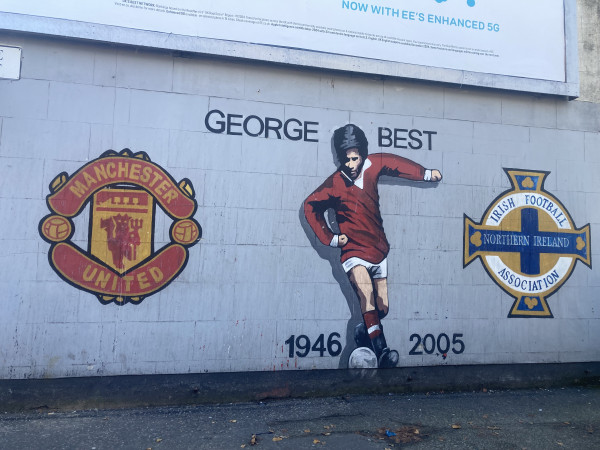
The George Best Mural on Blythe Street in Belfast. Photo: Carsten Germann for event-breaks.com
George Best? Just Around the Corner!
Possible. But it was surely one of the 470 games (179 goals) for Manchester United that will remain eternally memorable.
We continued to Blythe Street. In this side street – you have to be careful not to walk past it unknowingly – you’ll find the mural of the Northern Irish superstar, the only one listed as “George Best Mural” on Google Maps. It shows him in his United jersey with the ball, between the club logo of the “Red Devils” and the crest of the Northern Ireland Football Association.
Belfast, like Londonderry, which we visited first on our tour, is a city full of murals. They reflect the history of “The Troubles,” the long-smoldering political conflict formally ended by the Good Friday Agreement on April 10, 1998.
George Best's image can also be found on Woodstock Road in the east of Belfast.
Two years before his death, I studied George Best for DIE WELT in 2003 after one of his last alcoholic relapses (“I’d like to join Alcoholics Anonymous. The problem is: I’m not anonymous.”), and I honored him in my 2007 book Football’s Home – Tales from English Football. The text was then illustrated with George Best’s mural at Northern Ireland’s national stadium Windsor Park.
It can be found at one of the stadium entrances and also shows Best in his United jersey, rather curiously not in Northern Ireland’s green kit. Flowers and scarves are still laid there to this day.
George Best, on the other hand, is depicted in green and white on a house facade of a modest apartment block in Cappagh Gardens in Cregagh.
When George Best was laid to rest on December 3, 2005, 100,000 people lined the streets of Belfast. “Farewell to the Master” was the last headline featuring Best. Robert Crossett, from Belfast’s infamous Shankill area, was there too: “I admired this man since I saw him play against Holland in the seventies,” Crossett said, “it’s the first time this country was ever united – and it happened at a funeral.”
Don't miss an update
Get selected highlights about sports, events and travel - short, relevant, no spam.